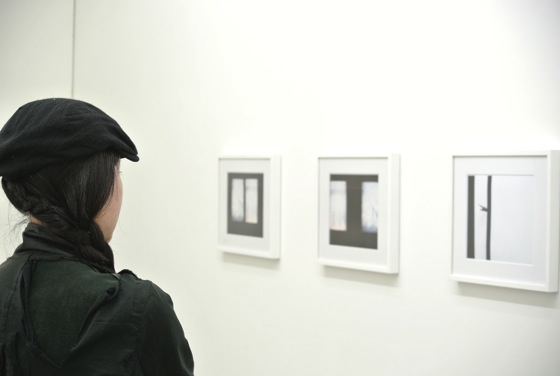
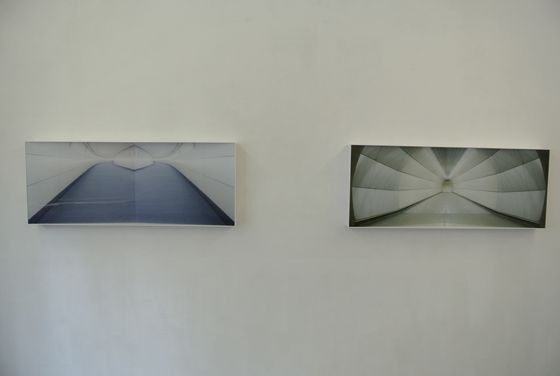
Maiko Haruki is a promising artist who experiments with films to achieve new expressions in photography. She intentionally creates under or over exposed images, which makes the photographs almost all black or white. Even in the darkroom, she moves around the negatives to print the blanks between the negatives and uses as an element of her work.
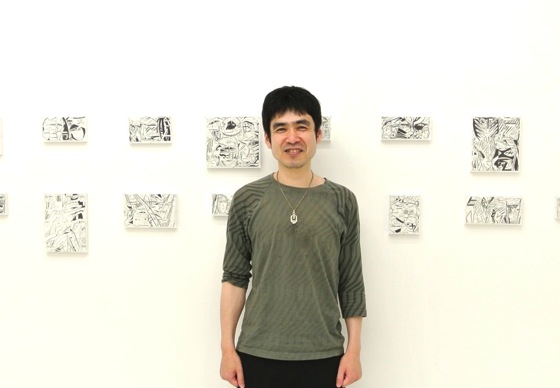
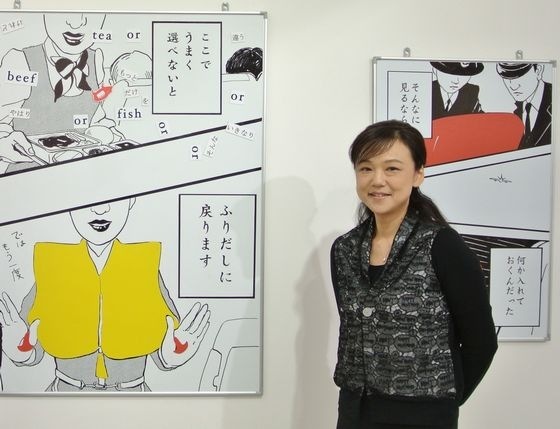
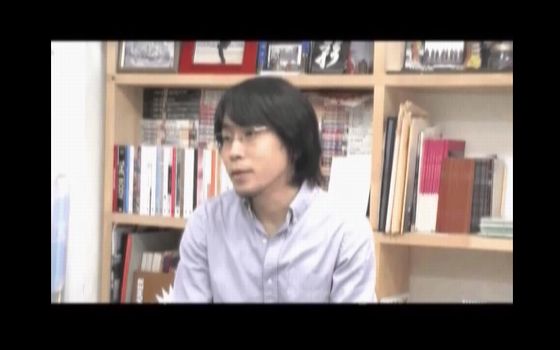
After graduating from university majoring in oil painting, Yokoyama chose to draw manga which is widely known for his unique style. His manga doesn't have a dramatic conclusion or touching ending. Simply, time passes by and things go on but in a dynamic or funny way. Yokoyama doubts emotions and words since it may prevent us from understanding our complicated sensualities. Yokoyama talked how he developed his style and how he captures the world. He suggests us to see things without labeling them. Not to label with human perceptions.
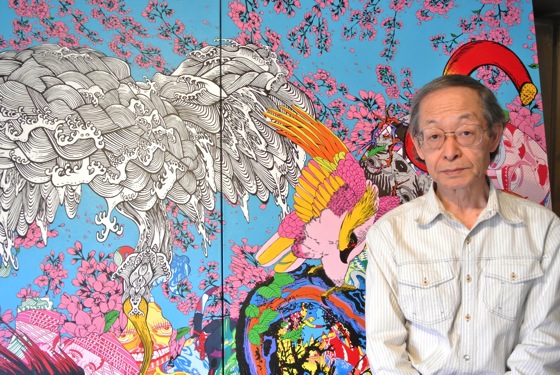
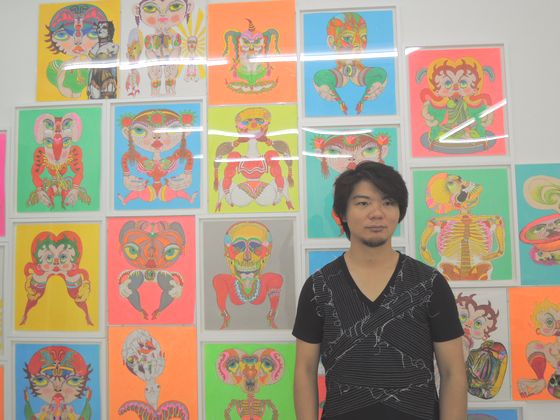
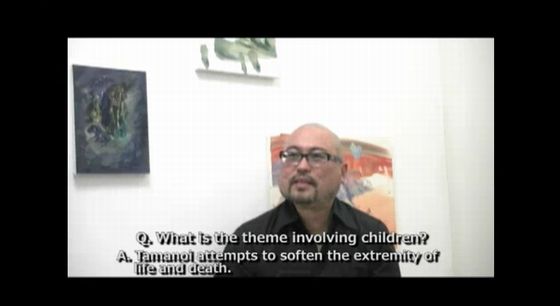
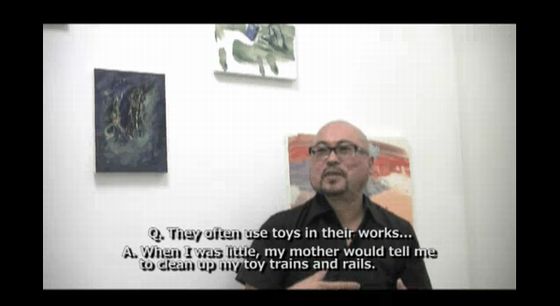
Keiichi Tanaami is a painter who started his career as a successful graphic designer/art director. Now, he is in mid-70s, but still his creation is developing and all of his works are really energetic. His unique colors and motifs were brought from his life experiences including the war and a serious illness. Although it sounds tragic to us, Tanaami got through those difficult circumstances by finding a source of pleasure in art. He'd drawn anything attracted him and they became all of his important motifs.
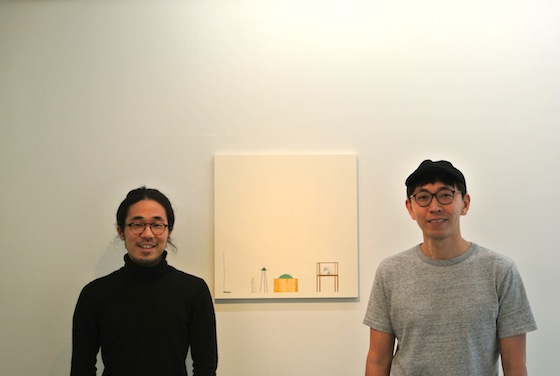
Kondo is a young painter who uses traditional Japanese techniques and restructures it with modern motifs. On the other hand, Hirayama draws intuitional lines with a black marker pen on paper. His drawings are in between objects and icons. Their styles are totally different but exhibited in one gallery space under the exhibition titled "Wood board, Paper & Mobile phones" at MA2 Gallery.
Kei Imazu is a promising artist who uses her impressive technique to formulate new imageries. In her exhibition "Puzzle" at Yamamoto Gendai, she chose old master pieces such as Delacroix's paintings as a base component and covered them with many kinds of motifs cut out from photos which she took after the 3.11 Tohoku disaster.
Ivan Vartanian is the founder/owner of GOLIGA, a publisher of photography books and producer of beautiful limited-editions. Under the GOLIGA label, he also organizes exciting events. Goliga events foster collaborations between photographers and participants to create a book, a photograph, or some type of experience particular to that moment.
Ando draw his works not by painting, but by dyeing cloth using a traditional dyeing technique called "ro-ketsu-zome". Ando connects his emotion with his physical experience and expresses it in his work. He thinks emotion is like a deep vast water space changing its color and shape flexibly.
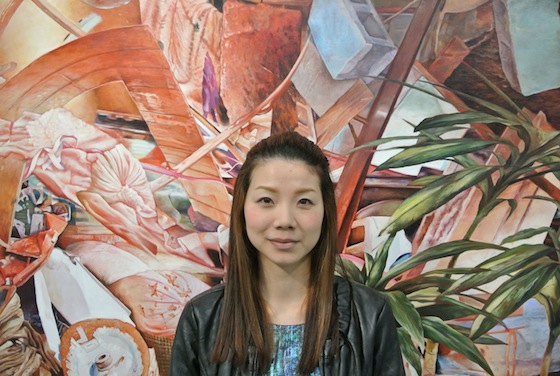
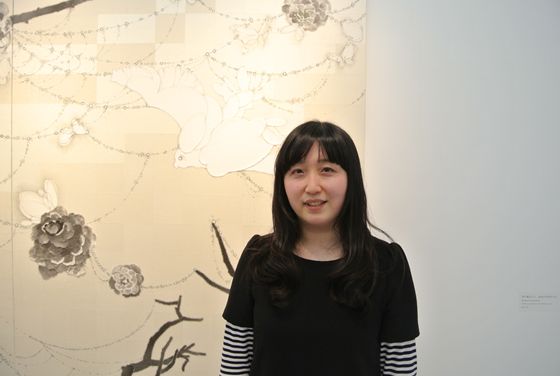
Myth and folklore blended motifs leaping on elaborately created background. Nana Funo is a Kyoto-based artist who is developing intricate layered paintings by using art materials such as clear gesso, pen-style masking fluid and dye markers, in her own way.
Watanabe is a young painter plays with that human being's perception. Many colorful shapes are floating in his painting. One shape looks like a bird when another looks like an umbrella. He told us that what you will find depends on your own experience.
Artist talk titled "Artist studios today" by Kohei Nawa, Yusuke Komuta and Naoki Tomita was held at G-Tokyo. As we may imagine as a typical artist who works lonely in a studio, their styles are not like that. Nawa's studio works as a team to solve problems and respect each abilities to overcome any difficulties. Other two young painters have opened a new space last year and looking for their new way as a creation space.
At a first glance, it is hard to tell how Yuko Someya's work was created. It may look like a painting but actually a collage of papers cut out or torn. Her work stands out not only for its dynamic structure, but for its details such as hand written patterns and textures of paper. She talked about connections or relations which have been changed since internet came to our life.
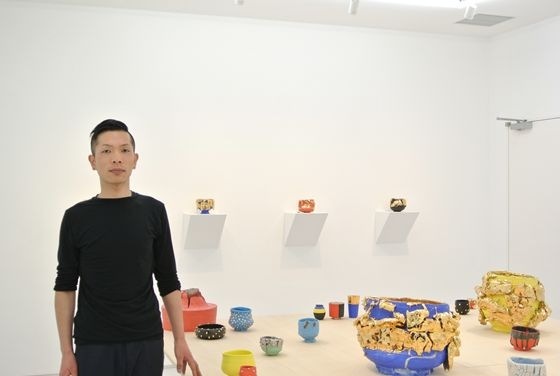
Takuro Kuwata is a young artist who works in ceramics. He has developed his own style originally starting from traditional techniques. During the interview, he shared his ideas behind joyful colors, forms and materials which distinguish him from traditional ceramic art. His works are powerful and happy. He respects and enjoys the power of nature by bringing its characters directly into his work.
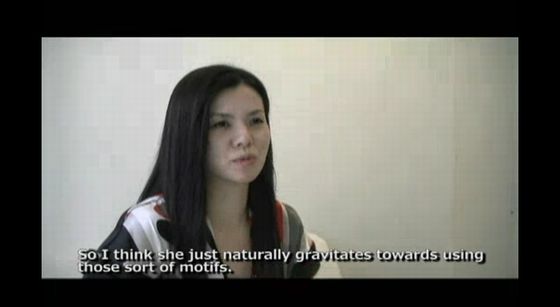
While interviewing Nagashima, one question repeatedly came up in my mind. "Do I really understand my own character?" She told me about her interest toward the subconscious part of human beings. Her work provides a place for viewers to think about who they are.
Tomoko Fukushi's works are drawn on a white board with a black parmanent marker. "Why drawing on a white board?" may be one of the questions the viewers ask themselves. This question is a good point to start a journey through the life of an artist who tried to find her own expression.
Makiko Kudo's painting recalls your memory and opens your inner sense. Kudo has a very sensitive perception to discern what she likes and what she cares from her surroundings. She depicts what she felt carefully but dynamically on a canvas. Through the interview, you will know how many of her memories are hidden in one painting. And that must be the reason why her paintings stimulate your inner sense.
Opened his own gallery in 1996, Tomio Koyama has been one of the most important gallerists, especially known as bringing Takashi Murakami and Yoshitomo Nara to the world wide audience. Through the interview, he told us the importance of doing what others are not and having your own way of thinking.
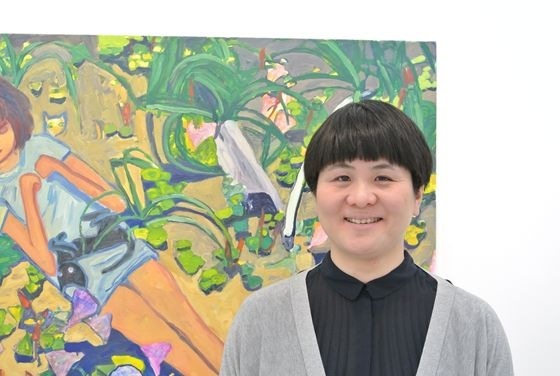
Girls with flowing hair, blossoming flowers in pink and purple, green and cream polka dot dresses, birds and lions inhabit Sakae Ozawa's paintings. The colorful, fantastic themes in her paintings overwhelm you and strike you as overly girly-girly at first. But getting to know the artist, you realize that her paintings are anything but saccharine fairytales.
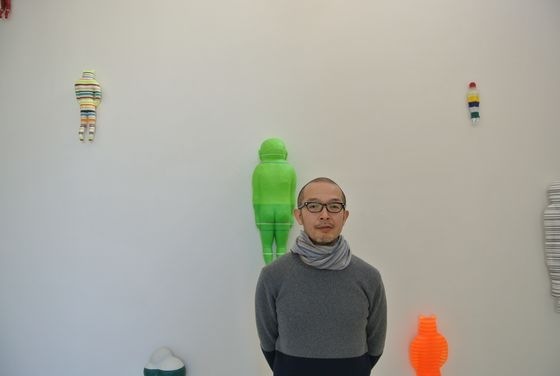
Kyotaro Hakamata is an artist known for his colorful striped sculptures. His work stimulates our imagination. In this interview, he told us that his creation is based on the tolerance of uncertainty. Don't let your imagination limit your creativity.
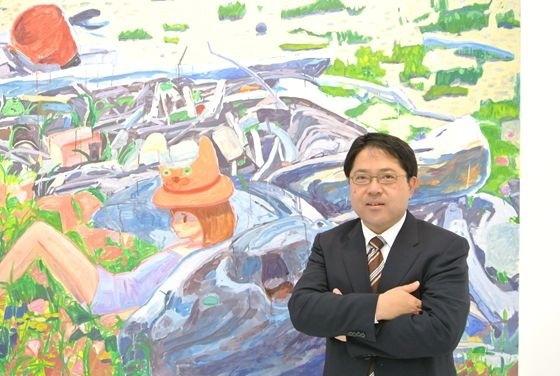
Mr. Mori is a tall, gentle-mannered gallerist with a discerning eye. He defines fine art as objects that appear between artists and physical objects or sceneries. The artists he represents are dynamic but some what humorous at the same time. We asked how him developed his perception towards art.
After viewing the details of her drawings up close, one shouldn't be surprised by Naoko Sekine's large hands and elegantly long fingers, despite her petite stature. Using only pencils--and a stylus at times--she fills up large canvases with both powerful fish scale-like imprints and soft puffs of graphite clouds.
Now in its third year, Osaka Canvas Project is the most up-and-coming outdoor art festival in Japan. Using a wide range of outdoor sites and several indoor spaces across Osaka prefecture, it aims to enhance the attractiveness of the region drawn by the artworks.
We had the chance to talk to Sugaya, the owner of Gallery 360 Degrees, one of Tokyo's oldest contemporary art galleries, about their impressive artist lineup and life changing encounters with artists that they have seen through the past few decades.
This is a book about the new generation in Japanese contemporary art after Takashi Murakami, including many artwork images all in color. I interviewed her over skype asking why she started to work on this book and how things went during the process.
NANAZUKA is a gallery found in 2005, introducing artists with novel expression. Some are renown illustrator and fashion designer whom we might have missed to appreciate as an artist. Nanazuka introduces them to place them into the art history...
We have interviewed Yamamoto about the artists, Fukaya and Yanobe before. But this time, we asked her about how she started her gallery and what she cares for choosing artists to represent.
We interviewed Mr. Ishibashi who organized this fair and runs a commercial gallery by himself about why he started the fair and how he sees the art industry in Japan...
We were lucky to have an opportunity to listen to TOKYO FRONTLINE's organizer, Goto's thought about Japanese art fair and Japanese contemporary art world. TOKYO FRONTLINE's interesting and novel ideas seems to stem from his different origin from the art world.
Kosuke Tsumura designs fashion that is survival-themed, but also works as an artist. In straddling both genres, fashion and art, what exactly would be the uniquely Japanese style he showcases?
You can purchase a work through the secure payment service PayPal from all over the world. Under normal circumstances your purchase will reach you in 2-3 weeks. Further details check FAQ: Payment>>
4-8-21-406, Ikejiri, Setagaya-ku, Tokyo, Japan
Art Dealer No.308951007986
copyrightcAZITO all rights reserved
art works on this site are copyright of the individual artists
















 email newsletter
 facebook
 twitter @azito_art
 Blog on tumblr
 RSS - Azito Topics